MiaProva Expands Its Optimization Leadership with Powerful AEP, RT-CDP, and Cross-Platform Integrations
Optimization teams have never had more data, more tools, or more pressure to drive meaningful business impact. But as the ecosystem has grown more powerful, it has also grown more fragmented. Teams are now expected to connect experimentation, analytics, audience management, activation, and governance across multiple platforms — all while keeping programs scalable, observable, and efficient.
That is exactly where MiaProva continues to lead.
For years, MiaProva has helped the optimization community bring structure, visibility, and operational excellence to experimentation and personalization programs. From managing Adobe Target programs more effectively to giving teams stronger governance, workflow support, and organizational clarity, MiaProva has focused on solving the real-world operational challenges that often limit optimization success.
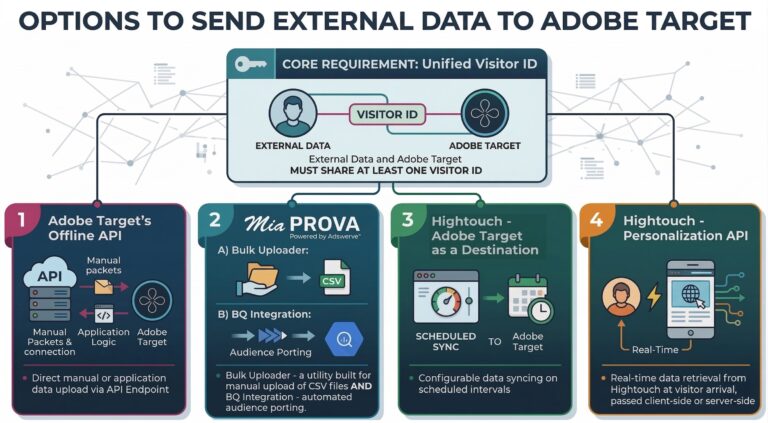
Now, MiaProva is expanding those industry-leading Optimization Management capabilities even further with impressive integrations across Adobe Target, Adobe Analytics, GA4, Customer Journey Analytics (CJA), and BigQuery to Adobe Experience Platform (AEP).
This evolution is not a departure from MiaProva’s roots. It is a natural extension of them.
Powered by Adswerve Expertise: Thought Leadership in Action
MiaProva’s expansion into Adobe Experience Platform is not happening in a vacuum. It is a direct reflection of the deep platform expertise and hands-on consulting experience that Adswerve brings to clients every day.
Adswerve has long been one of the most respected consulting partners in the Adobe and Google ecosystems. Its teams work at the intersection of data, technology, and strategy — helping enterprise organizations not just implement platforms, but extract meaningful, measurable value from them. That ground-level experience with real client programs, real data challenges, and real operational complexity is precisely what has shaped MiaProva’s evolution.
The integrations MiaProva is now bringing to market — across AEP, RT-CDP, Customer Journey Analytics, and beyond — reflect problems Adswerve’s consultants have encountered firsthand. When clients struggled with audience drift going undetected, Adswerve’s teams saw it. When organizations found their RT-CDP environments becoming cluttered with outdated segments, Adswerve was in the room helping them navigate it. When optimization and customer data programs operated in silos that undermined each other’s effectiveness, Adswerve’s practitioners were working to bridge that gap.
MiaProva is how that expertise scales.
For organizations that work with Adswerve, this means access to a platform that has been shaped by consulting insight rather than theoretical product roadmaps. It means value-added services grounded in the realities of running sophisticated digital experience programs — not just platform licenses and implementation checklists. Adswerve clients benefit from:
- Faster time to value with AEP and RT-CDP investments, supported by a purpose-built operational layer
- Proactive governance and observability built into the workflow, not bolted on after issues arise
- Strategic guidance informed by cross-client pattern recognition — the kind of perspective that only comes from working across industries, platforms, and program maturities
- A tighter feedback loop between consulting and product, so that what Adswerve learns in the field continues to shape what MiaProva delivers
This is what separates Adswerve’s approach from a typical implementation partner. The thinking does not stop at deployment. It continues through operationalization, optimization, and ongoing program maturity — and MiaProva is the platform expression of that continued commitment.
Built for the Optimization Community from Day One
MiaProva has always been about more than simply managing a backlog of tests. It was built to support the full reality of modern optimization programs: prioritization, visibility, governance, collaboration, reporting context, and operational scale.
That value has resonated with optimization leaders because the hardest part of experimentation is rarely just building a test. The real challenge is sustaining a program that can scale across teams, departments, brands, and technologies.
MiaProva has helped organizations do exactly that by bringing discipline and transparency to the work of optimization. It has supported teams that rely on Adobe Target and Adobe Analytics, and it has helped practitioners bring order to increasingly complex testing and personalization programs.
As digital organizations matured, so did the need for a broader operating layer — one that could span not just testing and analytics, but customer data, audiences, activation, and platform governance. MiaProva’s architecture was ready for that evolution.
Why AEP Was a Natural Expansion for MiaProva
One of MiaProva’s strengths has always been its architecture. Because the platform was designed to sit across systems rather than be constrained by a single point solution, it was well positioned to incorporate Adobe Experience Platform in a meaningful way.
That matters.
AEP is rapidly becoming foundational for organizations that want to unify customer data, support real-time use cases, enable stronger segmentation, and activate audiences across channels. But while AEP is powerful, many organizations still need better operational visibility around how it is being used, how audiences are behaving, and where issues may be developing.
MiaProva fills that gap.
By extending its platform to support AEP and RT-CDP, MiaProva gives organizations a more complete view of the systems that power personalization and audience activation. Instead of managing optimization in one place and customer data workflows in another, teams can connect the dots more effectively across Adobe Target, Adobe Analytics, GA4, CJA, BigQuery, and AEP.
This is a big step because it helps organizations move from isolated tooling to a more observable optimization and audience ecosystem.
AEP Dashboard Visibility That Teams Actually Need
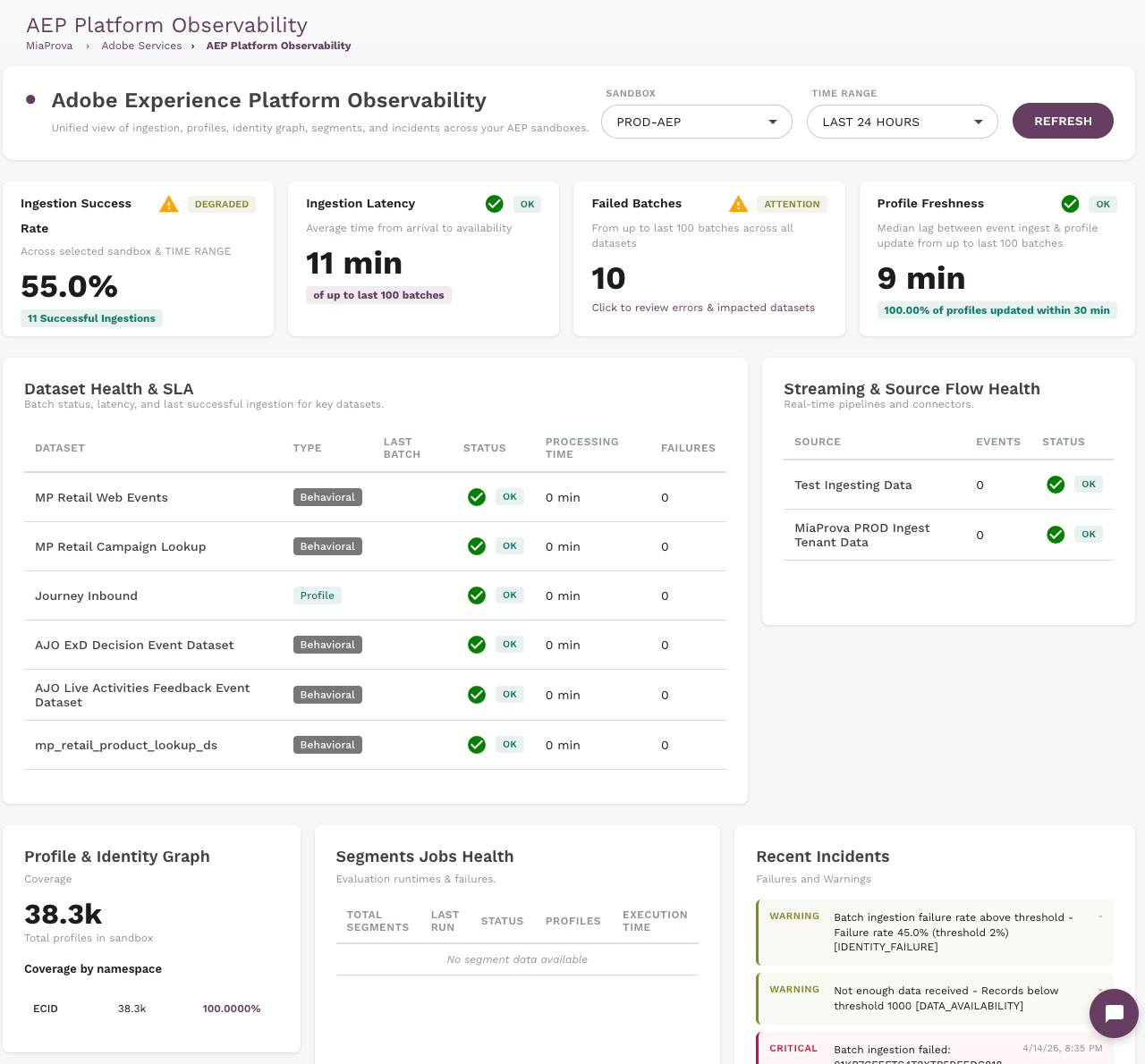
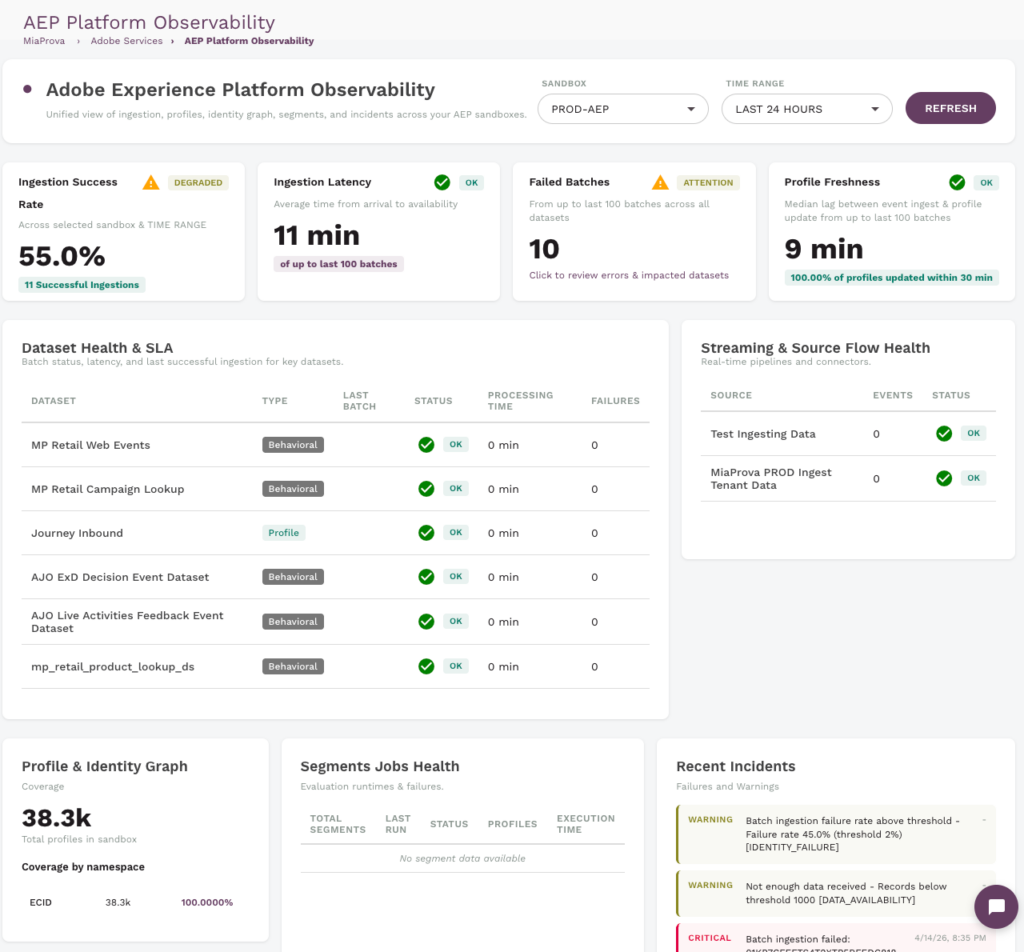
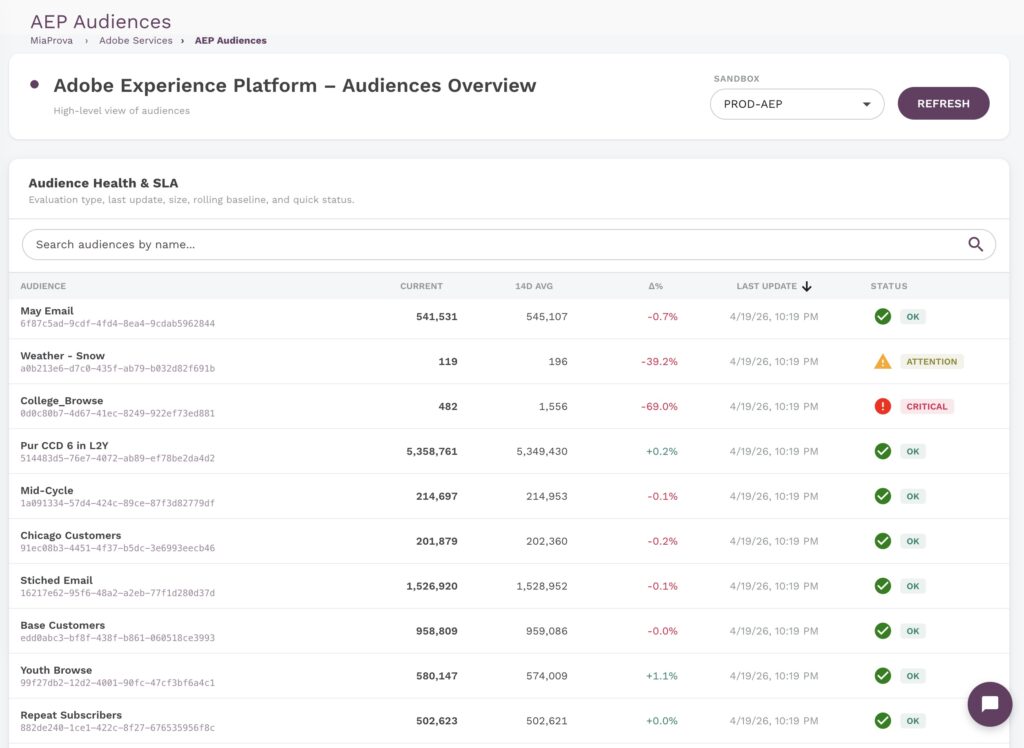
One of the most exciting additions is MiaProva’s AEP dashboard.
For many organizations, AEP contains mission-critical data and audiences, but visibility into day-to-day conditions can still be limited. Teams often know the platform is important, but they do not always have the right level of operational awareness around what is changing, what may be drifting, and where attention is needed.
MiaProva’s AEP dashboard is designed to solve that.
It gives teams a centralized view into the health, activity, and variability of the AEP environment, making it easier to monitor what matters and identify issues before they have broader downstream impact. This is especially valuable for organizations using RT-CDP, where audience behavior directly affects targeting, activation, personalization, and campaign execution.
The result is better visibility, faster detection, and stronger confidence in the audiences and data flows that power customer experiences.
RT-CDP Audience Size Alerts: Turning Audience Drift into Actionable Visibility
One of the most valuable capabilities MiaProva brings to RT-CDP users is audience size alerting.
Audience counts change. That is normal. But not all audience changes are expected, healthy, or harmless.
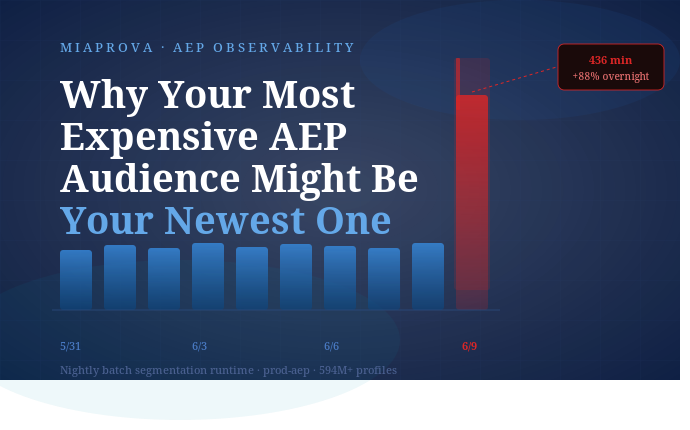
A sudden increase in audience size may indicate a qualification issue, identity stitching change, data ingestion anomaly, or unintended segmentation logic effect. A sharp decrease may signal broken data pipelines, schema issues, rule regressions, or qualification failures that could directly impact media activation, personalization campaigns, and downstream reporting.
Without proactive visibility, those issues can go unnoticed until performance suffers.
MiaProva addresses this by allowing users to define acceptable variance thresholds for RT-CDP audiences. When audience sizes move beyond those thresholds, MiaProva alerts the right stakeholders so they can investigate quickly.
That flexibility is important because not every audience should be treated the same. Some audiences naturally fluctuate. Others should remain relatively stable. MiaProva lets organizations set guardrails that make sense for their business, rather than forcing one universal threshold across every segment.
This creates real operational value:
- Teams gain early warning when an important audience shifts unexpectedly.
- Marketing and activation stakeholders get better confidence in the populations they are targeting.
- Analysts and platform teams can identify anomalies before they become campaign or reporting problems.
- Organizations build a stronger understanding of normal audience variability over time.
In practice, this means MiaProva helps turn RT-CDP audiences from passive assets into actively monitored business signals.
That kind of visibility is incredibly important as brands depend more heavily on audience-driven orchestration.
Why Audience Variability Visibility Matters
Many organizations know what audiences they have, but they do not always know how those audiences are behaving over time.
That is a major blind spot.
Audience variability can reveal far more than just changing counts. It can surface operational instability, seasonal patterns, campaign effects, implementation issues, and segmentation logic shifts. It can also help teams distinguish between healthy movement and problematic change.
By giving organizations clearer visibility into audience variability, MiaProva helps them improve both governance and decision-making.
Instead of reacting after an audience problem causes delivery issues or performance degradation, teams can see changes as they happen and respond with more context. That creates a more resilient RT-CDP practice and a stronger foundation for personalization at scale.
TTL for RT-CDP Audiences: Keeping the Audience Ecosystem Clean and Governed
Another important way MiaProva adds value for RT-CDP users is through TTL-focused audience management.
As organizations build more audiences over time, clutter becomes inevitable. Temporary segments stay around too long. Campaign-specific audiences outlive their usefulness. Legacy audiences accumulate. Teams lose confidence in which audiences are still active, still needed, or still safe to rely on.
This is not just an organizational nuisance. It becomes a governance problem.
That is why TTL matters.
By helping organizations manage the lifecycle of RT-CDP audiences — including identifying audiences that should be deleted when they are no longer needed — MiaProva can help teams keep their audience ecosystem cleaner, more intentional, and easier to govern.
This has several benefits:
- Reduces clutter and confusion in RT-CDP environments
- Lowers the chance of teams using outdated or unnecessary audiences
- Improves trust in active audience inventories
- Supports stronger operational hygiene and governance
- Encourages more intentional audience creation and maintenance practices
In short, TTL introduces accountability into audience management.
For organizations with growing RT-CDP footprints, that is a major advantage. It helps ensure that audience libraries remain useful rather than becoming bloated archives of old segmentation logic and one-off campaign artifacts.
Connecting Optimization, Analytics, and Customer Data
What makes this expansion especially compelling is that it is not just about adding one more integration. It is about bringing multiple layers of the digital experience stack together.
With support spanning Adobe Target, Adobe Analytics, GA4, CJA, BigQuery to AEP, and RT-CDP, MiaProva is uniquely positioned to help organizations operate across the systems that matter most.
That opens the door to significant value:
- Stronger visibility between experimentation and analytics
- Better understanding of audience changes and their business impact
- Improved confidence in the data feeding personalization and activation
- Easier investigation of anomalies across connected platforms
- A more unified operating layer for optimization and customer data teams
This cross-platform support matters because the future of optimization is not isolated testing. It is connected decision-making across experimentation, analytics, audiences, and activation.
MiaProva is helping organizations get there.
Especially Relevant as Adobe Summit Season Approaches
As Adobe Summit season arrives and organizations look ahead to the future of personalization, customer data, AI, and activation, there is growing interest in platforms that can do more than simply execute workflows.
Teams want visibility. They want observability. They want governance. They want operational clarity across increasingly interconnected systems.
That is exactly why MiaProva’s expansion is so timely.
Adobe customers are investing heavily in Adobe Experience Platform, RT-CDP, Customer Journey Analytics, and Adobe Target. But many still need a practical layer that helps them operationalize those investments more effectively.
MiaProva brings that layer.
It helps organizations not only use these platforms, but manage them better. It helps teams move faster with more confidence. And it gives leaders better insight into whether the engines powering personalization and activation are actually working as expected.
As conversations at Adobe Summit continue to focus on AI, real-time customer experiences, experimentation, and data-driven orchestration, MiaProva stands out by solving a very real challenge: making all of that operationally manageable.
The Next Chapter for Optimization Management
MiaProva has already established itself as a leader in Optimization Management by serving the real needs of experimentation teams and optimization leaders.
Now, by extending those capabilities into AEP, RT-CDP, audience observability, TTL-based audience governance, and broader platform integrations, MiaProva is helping organizations manage the next generation of digital experience operations.
This is more than product expansion.
It is the continued evolution of a platform built for the people doing the hard work of optimization, personalization, analytics, and audience management every day.
And as those disciplines continue to converge, MiaProva is increasingly becoming the system that helps them work better together.