Adobe Target Is Sitting on a Gold Mine — and Most Users Don’t Know It
Why Adobe should build a Profile Intelligence dashboard directly into Target, and why doing so will change how the entire industry thinks about personalization data.
There is a quietly remarkable capability living inside Adobe Target that most of its users have never fully explored: the visitor profile. It persists across sessions and devices. It runs computed JavaScript logic on every page load. It evaluates audience rules in under 100 milliseconds. It powers A/B test bucketing, Automated Personalization models, and Recommendations all at once.
And yet, for most Target practitioners, the profile is a black box.
They know it exists. They may have configured a script or two. But they have no idea how many visitors actually carry a given attribute, how fresh that data is, which attributes naturally cluster together, or which profile values are driving meaningful lifts in revenue or conversion.
The data is there. The insight is not.
That gap is the opportunity — and Adobe is uniquely positioned to close it.
What Is Missing: Visibility Into Your Own Data
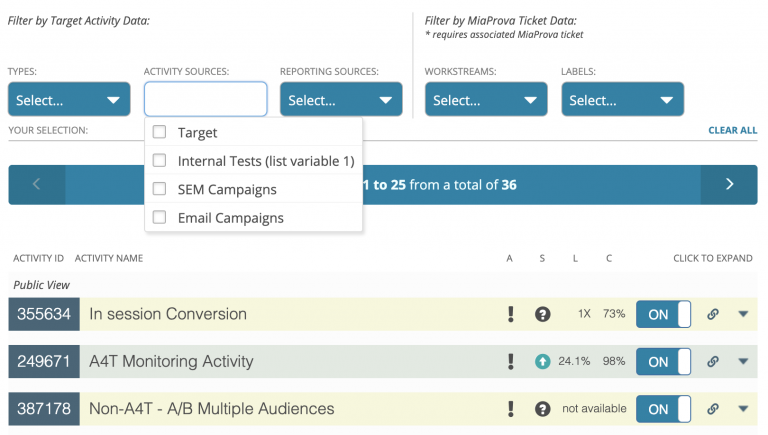
Right now, navigating to Profile Scripts in Target shows a list. Names, statuses, last-modified dates. That is the entire surface area of what Target exposes about its profile system.
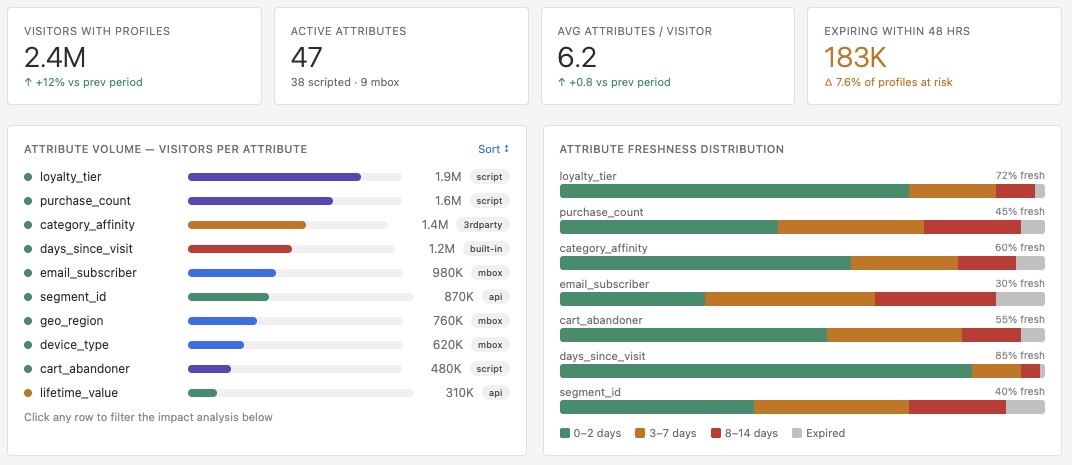
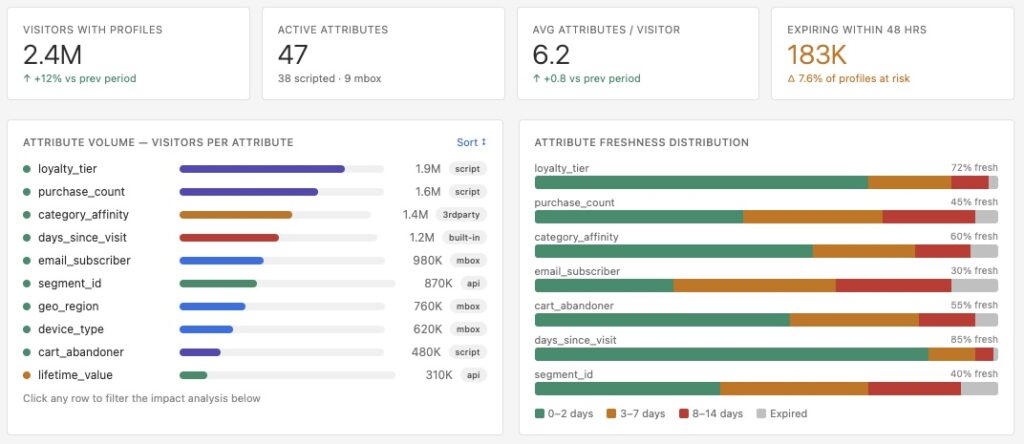
There is no dashboard showing how many of your 2.4 million profiled visitors carry a loyalty_tier attribute. No way to see that 72 percent of those visitors are also email_subscriber — a natural audience cluster sitting in your data, waiting to be activated. No alert when 183,000 profiles are about to expire, taking their behavioral signals with them. And no way to connect a profile attribute to an Analytics metric and ask: what does revenue actually look like for visitors with a loyalty_tier of gold versus none?
This is not a data problem. Target has all of this. It is a visibility problem — and visibility problems in martech have a specific, compounding cost. When practitioners cannot see their data, they revert to broad segments. When personalization becomes less personal, the business case weakens.
Adobe can break that cycle with a Profile Intelligence dashboard built directly into Target.
The Value It Creates
When a practitioner sees that lifetime_value is populated for only 13 percent of visitors, they immediately understand two things: this is a high-signal attribute worth protecting, and a CRM batch import via the Profile API could expand coverage to 60 or 70 percent of the base.
That insight does not require a data scientist. It requires a dashboard.
A freshness distribution view — showing what percentage of each attribute’s visitors fall in the zero-to-two-day bucket versus expired — reveals the temporal dynamics of behavioral data in a way that changes how practitioners design experiences.
An attribute overlap matrix showing that category_affinity and segment_id share only 36 percent overlap reveals genuine complementarity that makes audience building evidence-driven instead of intuition-driven.
The analytics impact panel is the truly differentiating piece. Let a practitioner select an Adobe Analytics or CJA metric, choose a profile attribute, and see immediately how that metric varies by attribute value — with lift calculations and suggested actions.
The practitioner who discovers that loyalty_tier: gold visitors generate 82 percent more revenue per session than loyalty_tier: none visitors does not need a data scientist to tell them the next step. They need to create an audience and build an experience — both of which they can do in Target right now, without filing a ticket or waiting for a report.
The Education and Empowerment It Delivers
One of the most underappreciated problems in enterprise personalization is not the technology — it is the gap between what the platform can do and what the average practitioner understands well enough to attempt.
A Profile Intelligence dashboard closes that gap through doing.
When practitioners interact with real data in a real product context, they learn why configuration choices matter to business outcomes. They stop needing training programs and start developing intuition. They stop filing tickets and start building audiences. Practitioners who understand a platform deeply do not leave it — and organizations where practitioners are empowered move faster, run more tests, and drive better outcomes.
That is practitioner empowerment in the most direct sense. And when it compounds across an organization, the platform earns its renewal not because procurement decided it was strategic, but because the people using it every day cannot imagine working without it.
The Natural Path to RT-CDP
Here is where the story gets particularly interesting for Adobe.
A Profile Intelligence dashboard does not just make Target more valuable — it creates the conditions for a very specific organizational realization. When practitioners can see what their profiles look like, they will also see what they are missing. They will notice that segment_id reflects a static CRM segment built six months ago and understand that what they actually need is a real-time segment that updates as customer behavior evolves. They will see that category affinity does not account for in-store purchase history — and understand that a richer signal exists in the data warehouse, just not yet accessible to the personalization engine.
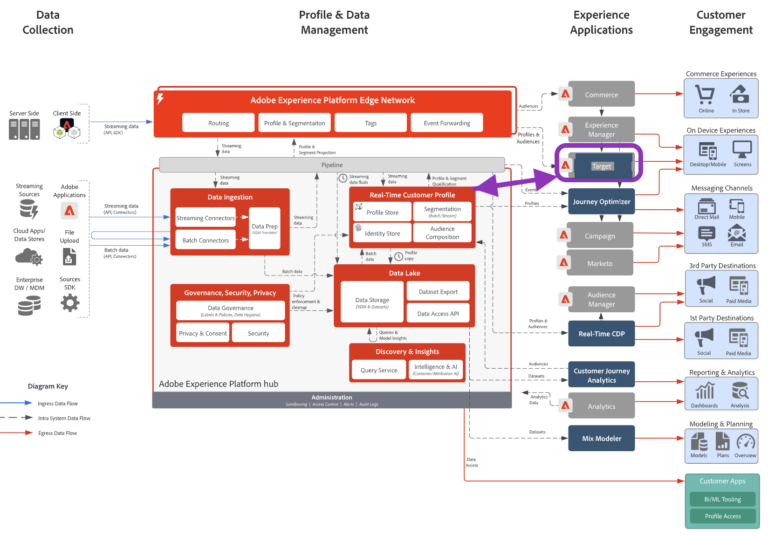
These are not problems that can be solved by a better profile script. They are problems of data unification, identity resolution, and real-time audience computation — exactly what Adobe Real-Time CDP was built to solve.
The practitioner who graduates from Target profiles to RT-CDP does not feel like they have been upsold. They feel like they have grown into the next level of their craft, with Adobe as the platform that showed them the way. Build a capability that creates awareness of a gap, then offer the product that fills it. That is one of the most powerful growth motions in enterprise software — and it is available to Adobe right now.
Build the Dashboard. The Rest Will Follow.
Adobe already has the data, the platform, and the adjacent products a more sophisticated practitioner will naturally grow into. What it needs is the bridge — the moment of clarity that shows users what they have, what they are missing, and what becomes possible when they are ready for more.
The platforms that win the next decade of personalization are not the ones with the most sophisticated algorithms. They are the ones that make their users feel capable, informed, and in control.
Profile Intelligence is that experience for Adobe Target.
Build it. The rest will follow.
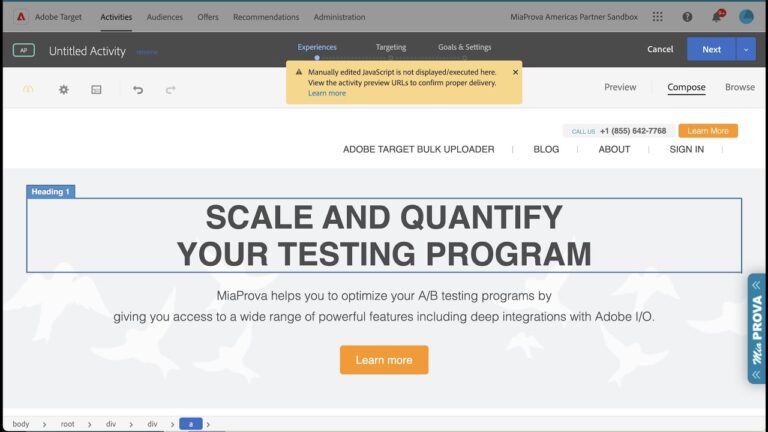
Here is a mock up of this concept with the backdrop of the Adobe Target UI: https://www.miaprova.com/demo/target-profile-intelligence.html
This post was written to explore a product concept for Adobe Target’s Profile system. The mockup referenced throughout was built as a working HTML prototype to illustrate the proposed interface.