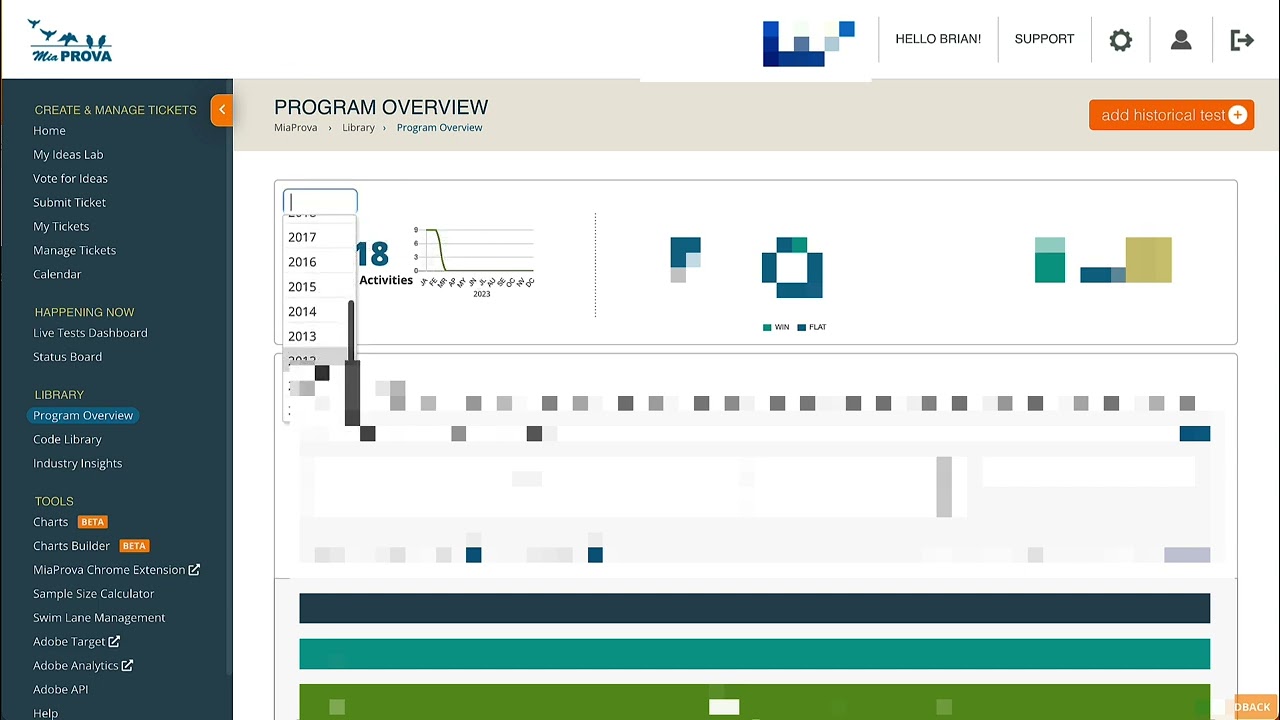
Historically, MiaProva would only provide Adobe Target usage reports from when they started using MiaProva. We have since changed that and now provide reporting on their usage of Adobe Target since they started using it. Many of our customers have been using Target since 2010 or even earlier!
The video is about a new feature in MiaProva’s last release which allows customers to view year-over-year reports on how they are using Adobe Target, including activity throughput. The report filters can be applied to exclude QA activities. The feature has been updated to go back to the beginning of the company’s relationship with Adobe Target. MiaProva’s tools for efficiencies and scale have helped many customers to run lots of activities year over year. The speaker encourages MiaProva customers to check out this new feature.
Transcript: (00:00) here’s a quick video on a small little feature that we incorporated with our last release that a couple customers that provided a few that I saw that was super cool so I thought I’d do a video to show so um what you’re seeing here is um just a report in terms of how you’re using Adobe Target and year over year um reporting in terms of activity throughput and historically what we’ve done is only started the year of the graph when Mia Provo when the company first started using miaprova but we’ve (00:33) since updated to go back all the way in time since the Adobe Target relationship at the organization started and so I thought it’d be interesting to kind of show you know some of this so here’s here’s an organization using Adobe Target since 2010 you can see the kind of the progression year over year so MIA purple customers give this a look um your report filters that you apply within here so when you want to filter out activities like QA that’ll apply on the data set as well so you can you kind (01:02) of see your company’s growth and the companies that are doing like lots of testing as you see here Mia Prova obviously helps with this you know with our standardization our tools for efficiencies and scale and so you’ll see a lot of companies out here that’ll have lots of companies or lots of activities run year over year and me and Prova is playing a big role in in helping scale that out here you can see some of these customers you know a thousand activities year over year um you know some years less but then you (01:37) know so far this year 223 different activities 1809 activities last year so exciting stuff Mia program customers go ahead take that a look um thank you
This video shows how organizations that use MiaProva can update their connection to Adobe I/O to make use of their optimization data in Adobe Target as well as Adobe Analytics by way of A4T.
Like you, we love data… As we are closing out the year here at MiaProva, we took a step back to examine some numbers and trends over the last year. Like you, we love data and thought we should share just a few of the interesting tidbits here. MiaProva Application 22,988 Adobe Target Activities are…
If only I have a dollar for every email, call, text from business stakeholders to ask ‘how’s my test doing?’! The new MiaProva/Slack integration serves as your new ‘Alexa’ or ‘Siri’ (but no, we don’t listen in your conversation!). Simply ask in the MiaProva Channel inside your company’s Slack account to provide you with a…
* How A4T can provide the mechanisms to align organizationally, scale your optimization program, monitor the program in aggregate, and leverage metric-driven AI * Automation with Target and putting the metrics and audiences from Analytics to work for you * Incorporating Automation to advance the journeys of your digital consumers
This video provides a brief overview of the Happening Now section of the MiaProva application. Here users can see all Activities that are live, any associated alerts, and real-time data for A4T and non-A4T Activities.
The MiaProva status board also provides management of all Live Activities and the MiaProva tickets across the various stages of the Activity lifecycle.
This video provides a brief overview of the Tools section of the MiaProva application. Here you can see some of the tools we provide in MiaProva, including our popular Chrome Extension.