Adobe Is a Leader in Forrester’s 2026 Experience Optimization Wave. Here’s What Target Teams Should Take From It.
By Brian Hawkins, Head of Optimization Technology, Adswerve
Forrester recently published The Forrester Wave™: Experience Optimization Solutions, Q3 2026, and Adobe was named a Leader.
That headline will make the rounds on its own.
What I find more interesting is what Forrester chose to evaluate—and how the definition of experience optimization itself has changed.
Because that tells us a lot more about where enterprise optimization is heading than any individual position on a Wave graphic.
The report is gated, and you can request it directly from Adobe here: https://business.adobe.com/resources/reports/forrester-experience-optimization-solutions.html
I am going to stay at a high level and leave Forrester’s specific scoring and language where they belong: in the report.
Experience optimization has become a much bigger category
This was my biggest takeaway.
For years, many of us in this industry largely associated experience optimization with experimentation, personalization, recommendations, and the teams responsible for operating those programs.
That definition is expanding quickly.
In the 2026 evaluation, Adobe’s experience optimization portfolio is centered on Adobe Journey Optimizer and Adobe Target within Adobe CX Enterprise.
Adobe Experience Platform provides the underlying customer data foundation, while Customer Journey Analytics adds another important part of the measurement layer.
That framing matters.
Experience optimization is no longer just about determining which version of a webpage performs better.
It is becoming a connected discipline spanning customer data, experimentation, personalization, analytics, recommendations, decisioning, journey orchestration, and increasingly AI.
For those of us who have spent years working with Adobe Target, I think that is worth paying attention to.
It does not make Target less important.
Target remains one of Adobe’s core engines for experimentation and personalization, particularly across web and application experiences.
But Target increasingly operates as part of a much broader optimization ecosystem.
And I think that is the right evolution.
The technology is often ahead of the operating model
This is where I stop talking specifically about the Forrester report and start talking about what I see in enterprise optimization programs.
I have been working with Adobe Target since it was Offermatica, and I have spent the last several years working with organizations trying to connect experimentation to AEP, Real-Time CDP, Journey Optimizer, Customer Journey Analytics, Adobe Analytics, and the broader Adobe ecosystem.
The capabilities available today are extraordinary.
Real-time customer profiles.
Identity resolution.
Cross-channel audiences.
Experimentation.
Personalization.
Journey orchestration.
Customer Journey Analytics.
Increasingly sophisticated AI.
The technology foundation is incredibly strong.
Where organizations often struggle is operating all of those capabilities as one optimization program.
A Target activity may be owned by one team.
An AJO journey may be owned by another.
AEP audiences and datasets may belong to a data organization.
Measurement may live in Adobe Analytics or CJA with another group entirely.
Each team can be doing its job well and the overall system can still become fragmented.
That fragmentation produces some very predictable problems.
Two teams can unknowingly run overlapping experiences.
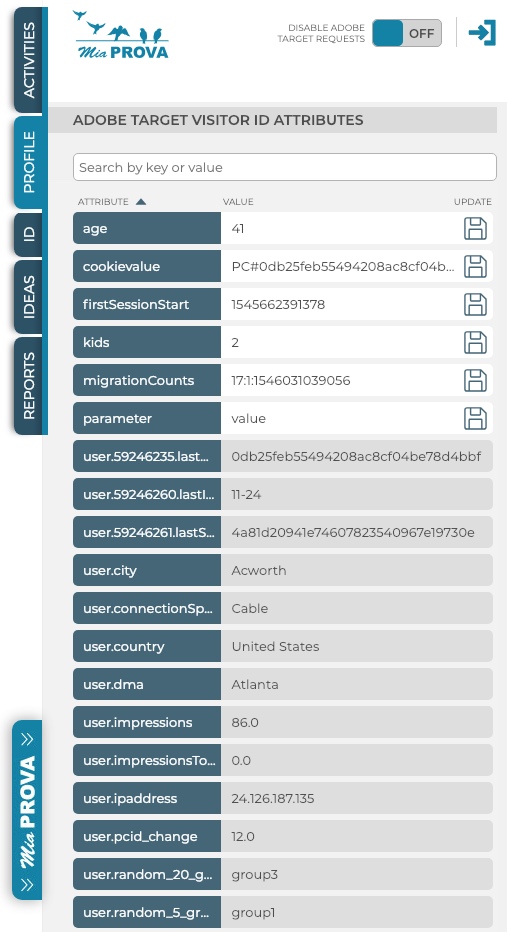
An audience can materially change and the team using it may not realize it.
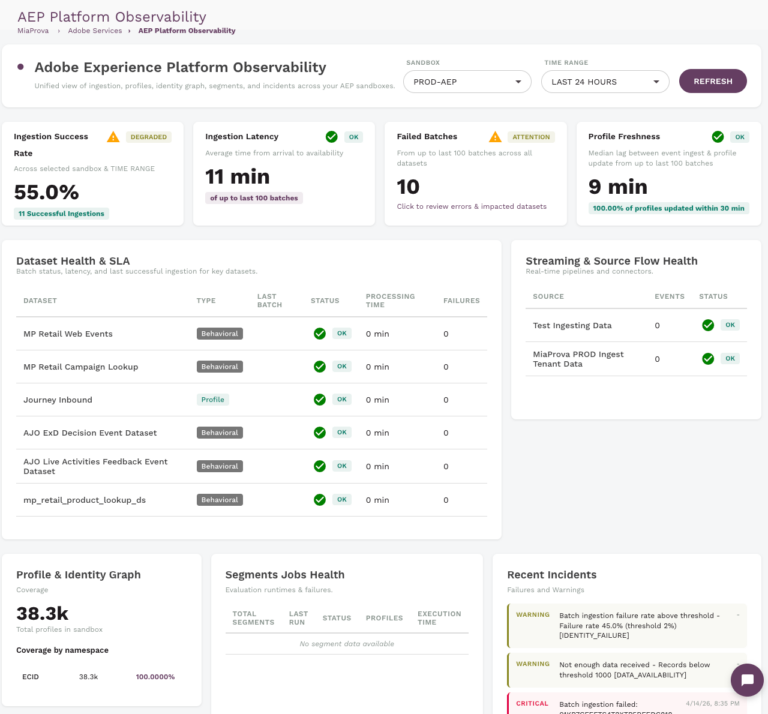
A batch ingestion issue can affect personalization downstream without the experience owner immediately understanding what happened.
An experiment can generate an important insight that never influences the next journey or campaign because the team creating that experience never saw the result.
A successful optimization program can accumulate hundreds or thousands of activities, audiences, journeys, datasets, and learnings without having a great way to understand how all of those pieces relate to one another.
Those are not failures of Adobe’s technology.
They are signs that the operating model around experience optimization has to evolve alongside the platform.
And I think that is becoming one of the biggest opportunities in our industry.
Three questions I would ask about your own optimization program
One thing I liked about the Forrester report is that several of its buyer considerations work equally well as a maturity assessment for organizations that have already selected their technology.
I would ask three questions.
1. How far does AI reach beyond content generation?
Generating copy, imagery, audiences, and experience variations is rapidly becoming table stakes.
The more interesting question is what AI can do across the optimization lifecycle itself.
Can an agent identify an opportunity?
Can it investigate performance?
Can it understand the audiences involved?
Can it identify something unusual in the data supporting an experience?
Can it recommend the next experiment?
Can it help configure that experiment?
Can it analyze the outcome and use what it learned to recommend what happens next?
Eventually, can it perform portions of that lifecycle autonomously within the governance and permissions established by the organization?
That is where this gets really interesting.
2. What does autonomous optimization realistically look like for your organization?
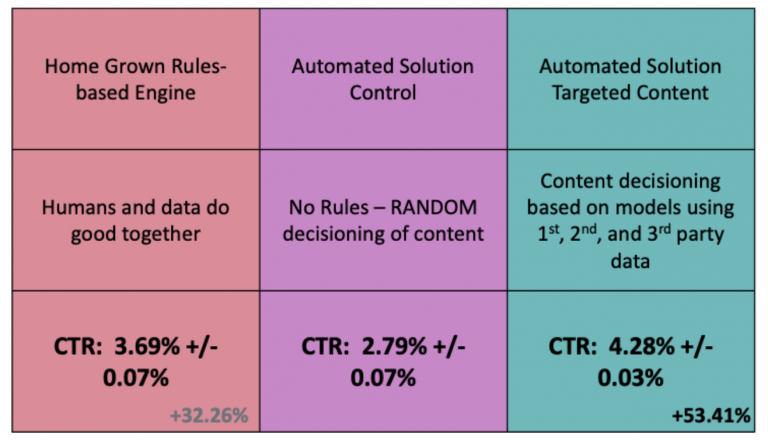
Forrester spends considerable attention on the movement toward agentic and increasingly autonomous optimization.
I think the word realistically matters here.
Some organizations may eventually allow agents to create experiences, configure experiments, manage audiences, analyze outcomes, and initiate follow-up actions with minimal human intervention.
Others will want humans approving nearly every meaningful action.
Both models can work.
The important question is where your organization wants the human in the loop.
Because simply adding an AI assistant to an inefficient operating model does not fix the operating model.
It may just make the inefficiency move faster.
3. Is your data foundation actually unified in practice?
Adobe has built a very powerful data foundation with AEP.
But having a unified customer-data platform and operating your optimization program as if the data is unified are not necessarily the same thing.
Are the same customer signals consistently available across experimentation, personalization, journey orchestration, recommendations, and measurement?
Can experience owners understand the health of the audiences they are activating?
Can they see when an upstream dataset or ingestion process changes?
Do teams know when the same audience is being used across several experiences?
Can they understand the dependencies between data and activation?
Adobe provides the architecture to make much of this possible.
The question for individual organizations is whether their implementation and operating processes are actually taking advantage of it.
That is worth measuring rather than assuming.
Where MiaProva fits
This evolution of experience optimization is one of the biggest reasons we have expanded MiaProva beyond traditional experimentation management.
MiaProva is designed to provide a program-level management, intelligence, and observability layer across the Adobe optimization ecosystem.
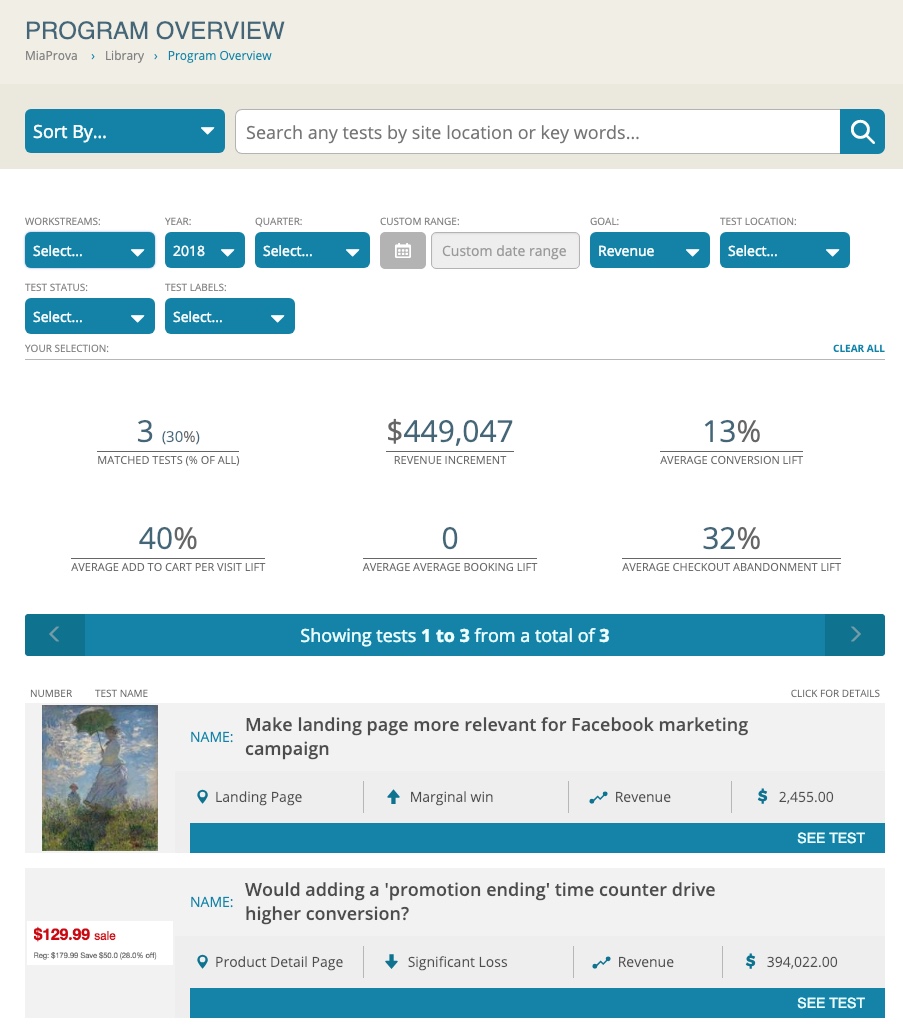
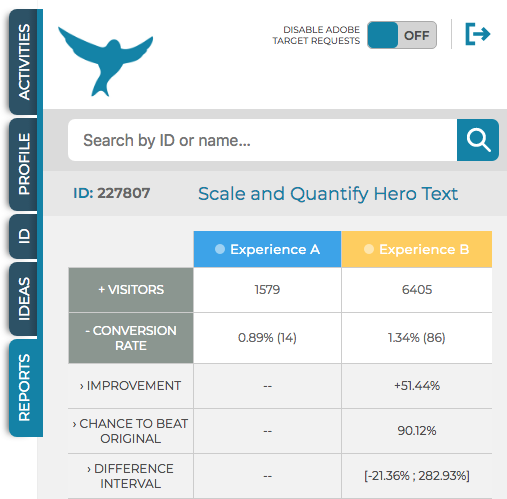
On the experimentation side, that means helping organizations manage Adobe Target as a program rather than simply as a collection of individual activities.
Teams can understand what is running, what is coming, where experiences may overlap, what has been learned, which activities require attention, and what should happen next.
As organizations adopt AEP and Real-Time CDP, that same program-level visibility can extend into the data powering those experiences.
Audience health.
Audience complexity.
Dataset activity.
Batch ingestion.
Governance.
Consumption.
Operational signals that can affect downstream personalization.
And as Target and Journey Optimizer increasingly operate as complementary parts of the same experience optimization portfolio, I believe organizations need better ways to understand experimentation and journey orchestration together.
That is why we have been building capabilities such as an activation calendar that allows teams to view experimentation and journey activity on a common timeline.
The goal is not to recreate Adobe’s applications.
It is to help organizations understand and operate the optimization program that spans them.
The agentic piece may be the most important part
Forrester’s description of where experience optimization is heading is particularly interesting to me because of its emphasis on agentic AI.
Adobe is clearly investing heavily in this direction as well.
But agents become much more useful when they can safely operate across the systems involved in an optimization program.
An optimization agent may need to understand an Adobe Target activity.
Then inspect the audience powering it.
Then understand the underlying AEP data.
Then query CJA or Adobe Analytics to understand performance.
Then determine whether something changed.
Then recommend—or eventually execute—the next action.
That requires more than an AI chat interface.
It requires governed, permissioned access to the systems and context involved in the optimization lifecycle.
This is an area where we have been investing heavily with MiaProva.
Our MCP tooling makes Adobe Target, Adobe Experience Platform, Real-Time CDP, Customer Journey Analytics, and Adobe Analytics available as agent-accessible surfaces.
That creates some fascinating possibilities.
An agent can investigate an experiment.
Inspect an audience.
Check data health.
Analyze performance.
Look for anomalies.
Connect those signals.
And eventually participate in larger optimization workflows while respecting the permissions and governance already established by the organization.
The goal is not to replace Adobe’s applications or Adobe’s AI strategy.
It is to help organizations and agents operate more effectively across the Adobe investment they already have.
I think that distinction is important.
As experience optimization shifts from individual tools toward connected systems—and eventually toward agent-assisted and increasingly autonomous workflows—the connective tissue between those systems becomes extremely valuable.
What I would do with the Forrester report
If you are already an Adobe customer, I would not read this report only as a vendor scorecard.
Use it as a mirror.
Ask whether experimentation and journey orchestration are actually connected inside your organization.
Ask whether the teams creating experiences can understand the audiences and data powering them.
Ask whether learnings from experiments consistently influence the next experience you create.
Ask whether your analytics, experimentation, customer data, and journey teams share the same definition of success.
Ask whether operational issues in the underlying data can be connected quickly to the experiences they affect.
And ask where AI can meaningfully remove work or improve decision-making rather than simply adding another interface to an already complicated process.
Forrester evaluating Adobe Target and Adobe Journey Optimizer together within Adobe’s broader CX platform is an important signal.
Many enterprises still operate these technologies through different teams, different backlogs, different workflows, and sometimes entirely different organizational structures.
Closing that gap may create as much value over the next several years as adopting any individual new feature.
Adobe has built an incredibly powerful foundation for experience optimization.
The next opportunity is making the entire optimization program operate like a connected system.
And if Forrester is right about where this category is headed, eventually some of the participants operating that system will not be people.
They will be agents.
That’s the part I think is going to get really interesting.
If you’re working through that evolution in your own Adobe program, I’d love to compare notes.