Optimization Should Be a Capability, Not a Tool
Most enterprise optimization programs take the shape of whatever platform was in place when the program started. A company that runs Adobe Target ends up with a program that looks like Adobe Target: its workflow, its terminology, its reporting limits. A company on Optimizely or a feature-flag stack builds its process around those tools instead. Then the analytics platform gets layered on top, whether that is Adobe Analytics, Customer Journey Analytics, GA4, or Amplitude, and the program inherits a second set of constraints from the reporting side.
Nobody decides to do this. It happens because the platform is the only concrete thing in the room on day one, so the process forms around it. But the result is a program whose operating model is an accident of procurement history. When the execution platform changes, and it will, the program has to be rebuilt along with it.
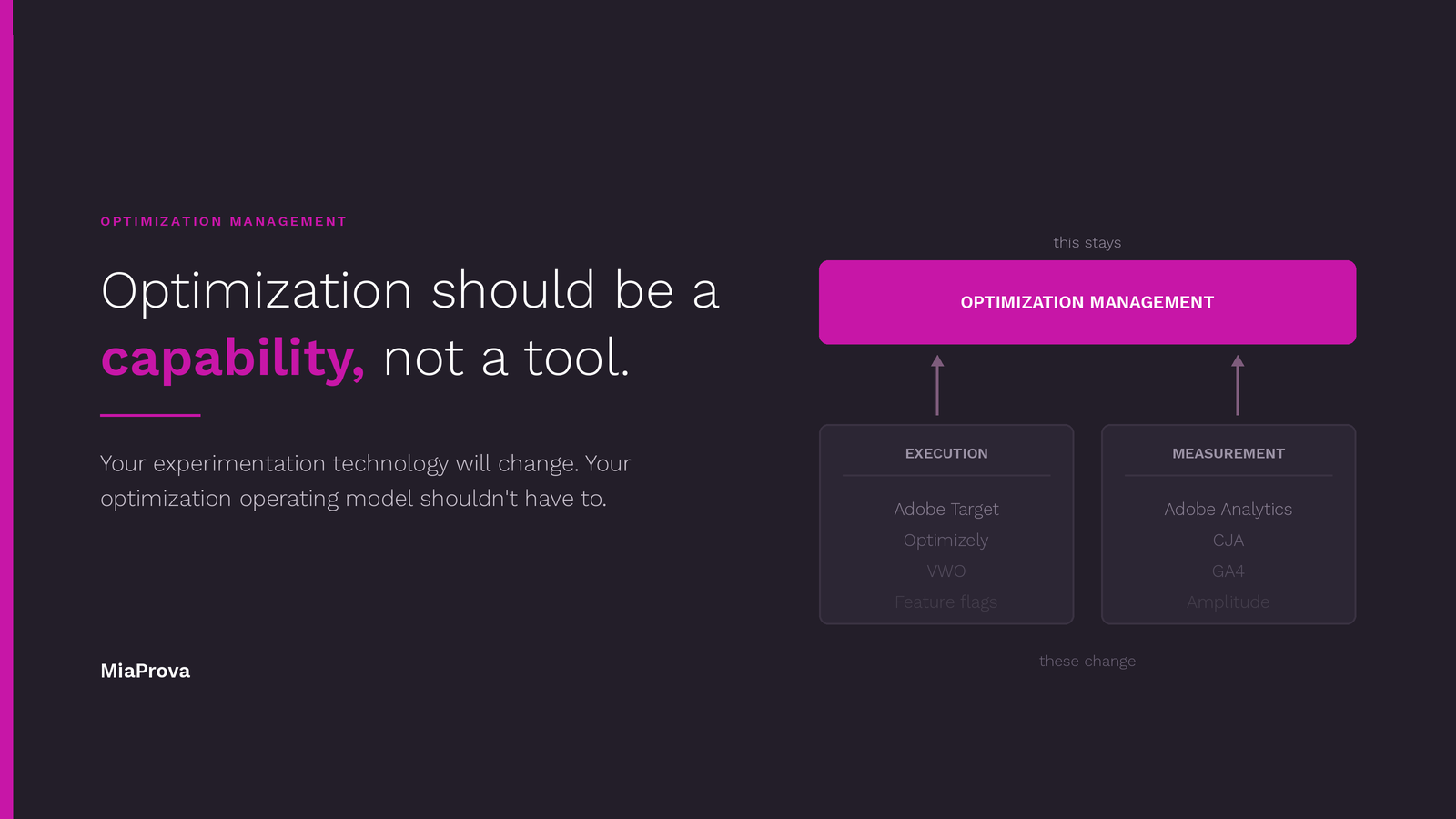
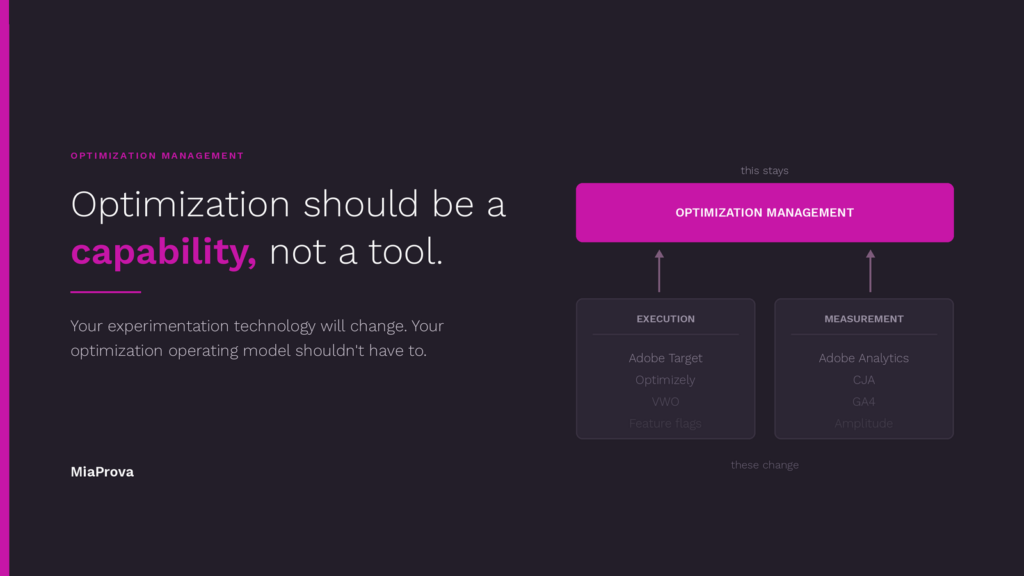
That is backwards. Your experimentation technology will change. Your optimization operating model should not have to.
The experiment is the smallest part of the program
Running an A/B test is not hard. Operating a mature optimization program is. The test itself is a few days of build and a few weeks of runtime. Everything around it is where the actual work lives: capturing and prioritizing ideas, designing and approving experiments, tracking activity status, monitoring performance and health while the test runs, making and documenting decisions, rolling results up into program KPIs, reporting to executives, and preserving what was learned so the next team does not have to relearn it.
Experimentation platforms solve pieces of this. The gaps get filled with Jira tickets, spreadsheets, analytics workspaces, PowerPoint decks, Slack threads, and the memory of whoever has been on the team longest. At ten experiments a year that patchwork holds. At a hundred it starts to fail, and it fails quietly, because nothing in the stack is responsible for the program as a whole.
Three layers, not one platform
A better architecture separates three concerns that most organizations currently blur together.
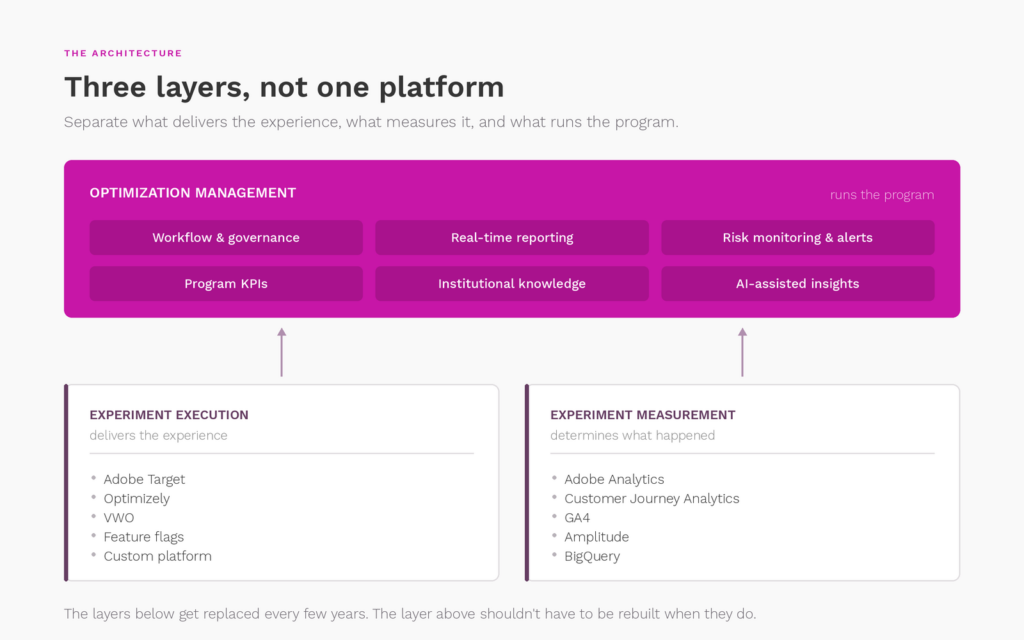
Experiment execution is the technology that delivers the experience to the visitor. Adobe Target, Optimizely, VWO, a feature-flag system, a homegrown platform. Its job is to serve variations correctly and reliably.
Experiment measurement is the trusted analytics system that determines what happened. Adobe Analytics, CJA, GA4, Amplitude, BigQuery. Its job is to be the source of truth the organization already believes.
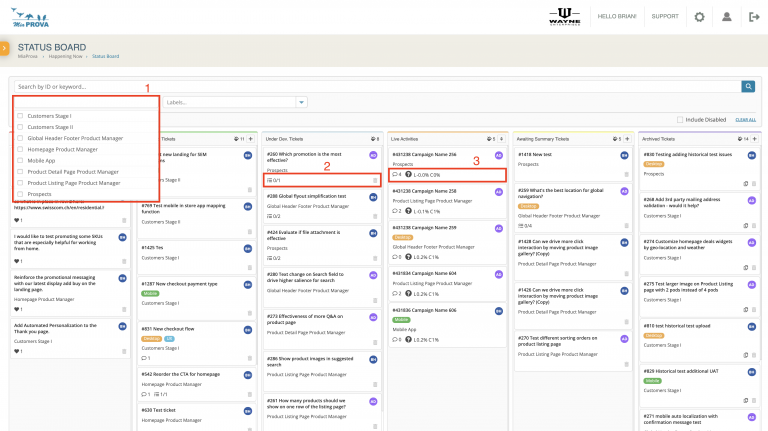
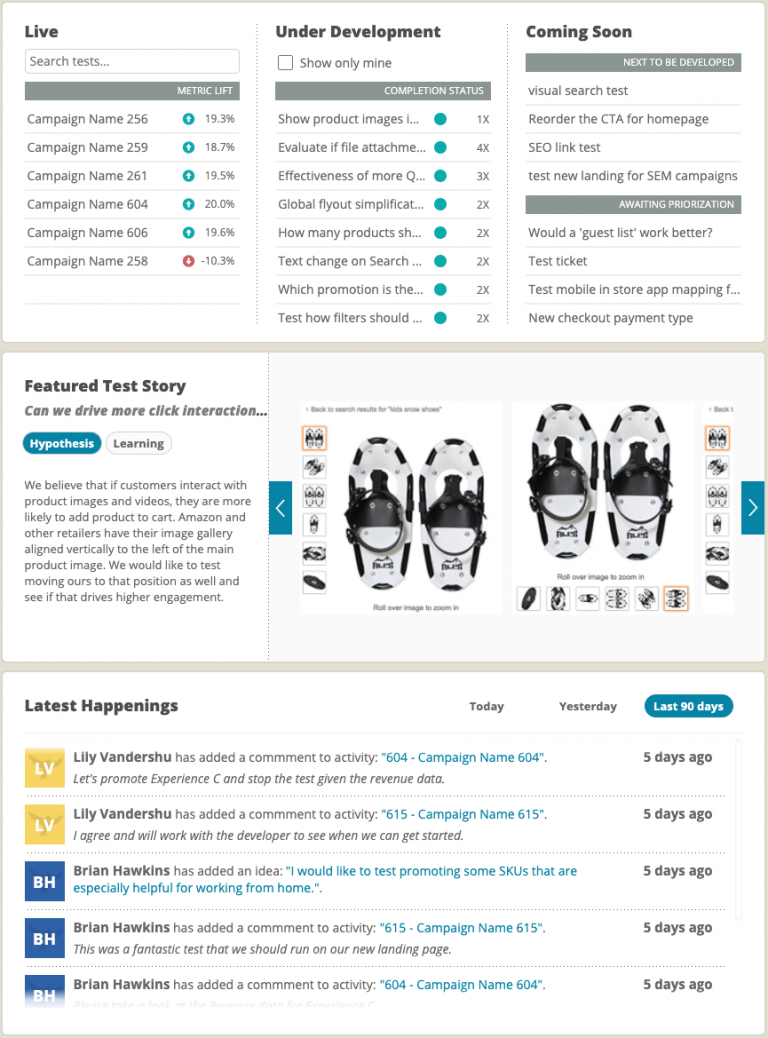
Optimization management is the operating layer above both. Its job is to run the program: what is live, what is scheduled, what needs attention, what is at risk, how fast the pipeline moves, what percentage of tests produce real wins, which business areas generate the most impact, what has already been learned about this page or audience or hypothesis, and what should be tested next.
Those questions should not require ten tools to answer. Today they usually do.
The alerts that matter fire before the analysis
Optimization teams spend a great deal of energy on the end of an experiment: significance, confidence intervals, the winning variation. Most of the serious risk to a program shows up at the beginning, and nothing in the typical stack is watching for it.
Picture a test scheduled to run three weeks. On day two the traffic split drifts to 53/47 against a 50/50 allocation. That is Sample Ratio Mismatch, and it means the result is already compromised. In most programs nobody looks until the scheduled readout, so the organization spends three weeks exposing visitors to a test whose outcome cannot be trusted, then argues about whether to rerun it. The same pattern applies to a variation producing a sharp detrimental lift on a revenue metric, a test whose traffic disappears because a deployment broke the targeting, or an activity that quietly stops receiving visitors.
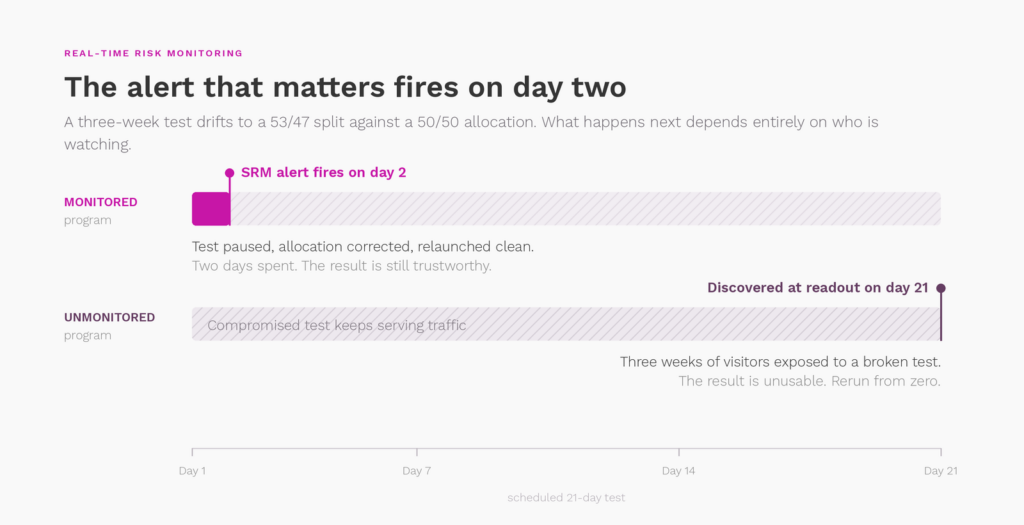
A program of any real size cannot rely on someone remembering to check. The optimization management layer should continuously evaluate every running experiment and surface these conditions when they occur, not days later during analysis. This is not a reporting feature. It is risk control, and it is the part of the operating layer that a program lead feels most directly.
The same logic applies to performance reporting generally. The old model treats reporting as an event after the test: someone opens the analytics platform, an analyst builds a workspace, the team reviews it, a decision gets written down somewhere. Reporting should happen while the experiment runs, from the same layer that is monitoring its health, so that performance and risk are visible in one place throughout.
Experiment KPIs versus program KPIs
Individual experiment KPIs tell you whether a test worked. Program KPIs tell you whether your optimization organization works. Those are different questions and they get asked by different people.
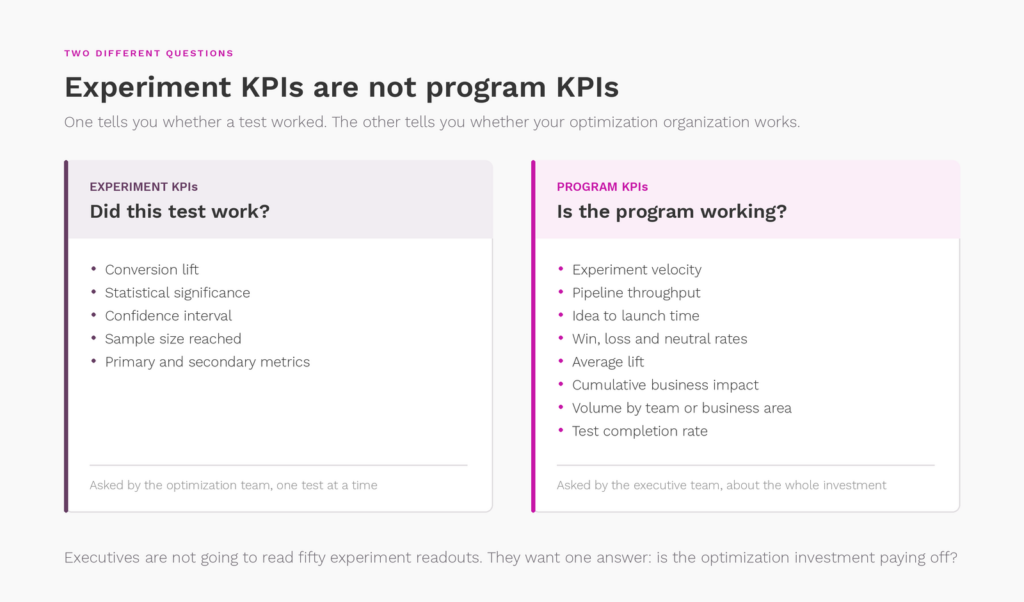
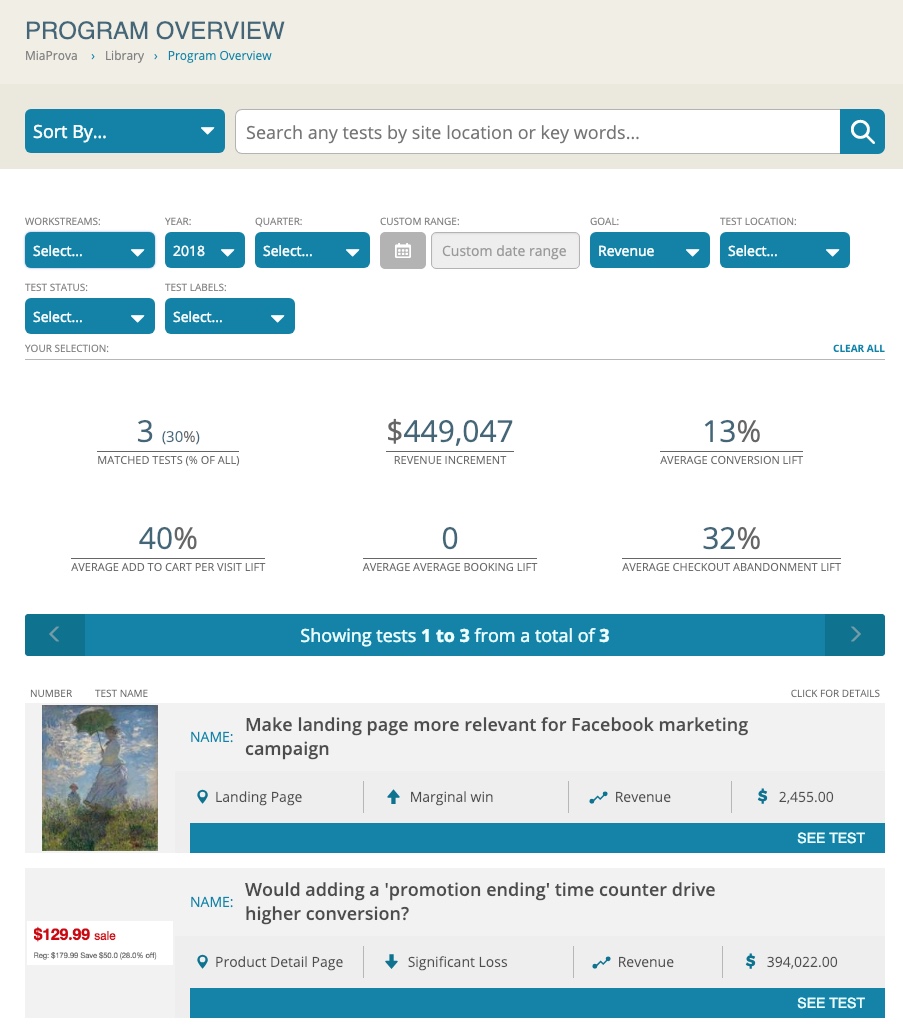
A mature program should know its experiment velocity, its pipeline throughput, its average time from idea to launch, its win, loss, and neutral rates, its average lift, its cumulative business impact, its volume by team or business area, and its completion rate. Executives do not want fifty experiment readouts. They want to know whether the optimization investment is paying off, and they want that answer without an analyst spending a week assembling it. An optimization management layer should be able to produce it on demand.
The measurement layer stays exactly where it is
Separating management from measurement does not mean replacing the analytics platform. It means the opposite. If the organization trusts Adobe Analytics, Adobe Analytics remains the source of truth. If it is moving to CJA, CJA feeds the program. If product teams live in Amplitude, Amplitude supplies the behavioral and experiment data. The management layer reads from those systems and turns the data into a repeatable operating model.
I want to be honest about what that requires, because a skeptical reader should ask. Computing lift, significance, and SRM against four analytics platforms is not a thin abstraction. Each platform has its own data model, its own metric semantics, and its own way of joining experiment membership to outcomes. Adobe Analytics and CJA can disagree on the same metric for the same period for reasons that are well understood but not obvious. A management layer that claims platform independence has to have done that integration work for real on each platform, not just on the one it started with. That is a fair test to apply to any vendor making this argument, including us.
The learning has to outlive the people
The problem that gets worse as programs mature is that the organization forgets what it learned. A team runs hundreds of experiments over several years. Analysts leave, agencies rotate, product teams reorganize. Eventually someone proposes a test that is nearly identical to one that ran three years earlier. The company paid for that experiment. It just did not keep the result.
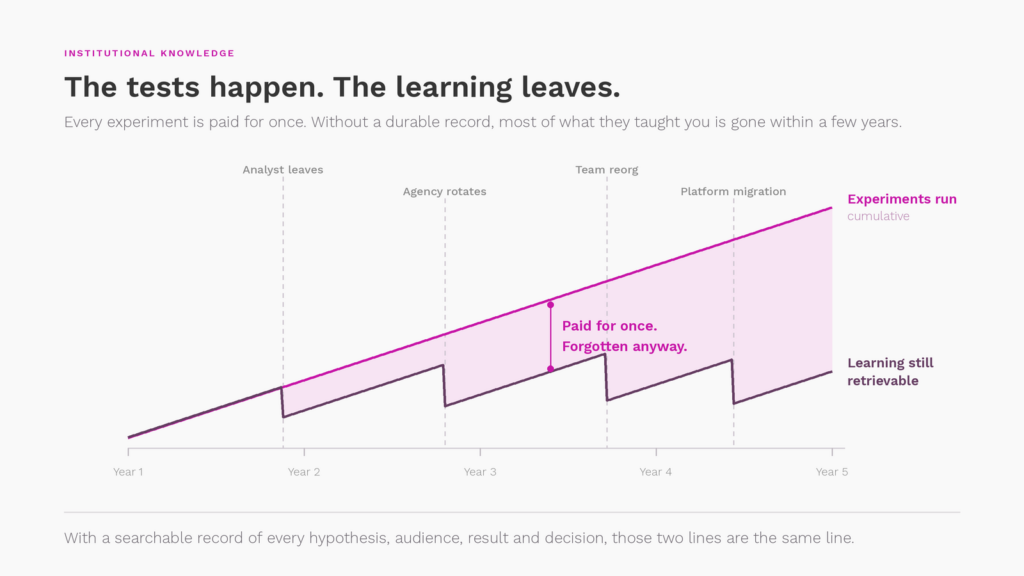
Optimization management should create durable institutional memory: every hypothesis, audience, experience, result, decision, and learning, searchable and structured. With AI on top of that history the value changes in kind. Instead of asking what to test on checkout, a team can ask what every checkout experiment in the last five years has taught them, and what that history suggests testing next. That is a different sort of optimization program, and it is only possible if the learnings live somewhere that survives platform changes and personnel changes.
Why the platforms will not build this
The obvious objection is that the execution platforms will eventually build all of this themselves. Some of it, yes. But there is a structural reason they will not build the version that matters.
Adobe Target will build program management for Adobe Target users. Optimizely will build it for Optimizely users. Neither will ever build it for an organization that runs both, or for an organization migrating from one to the other, or for one that measures Target experiments in GA4 because that is where the business already lives. The platform’s incentive is to make the program more dependent on the platform. The organization’s interest is the reverse: an operating model, a KPI history, and a knowledge base that survive whichever platform decision gets made next. Those interests do not converge, which is why the management layer has to sit outside the execution platform to do its job.
How we are building MiaProva
This is the philosophy behind MiaProva. It started as a way to run Adobe Target programs well, and Target remains the deepest integration. But optimization organizations increasingly operate across wider ecosystems, and MiaProva now supports programs using Adobe Target directly as well as programs on other execution technologies that report through Adobe Analytics, Customer Journey Analytics, GA4, or Amplitude.
Regardless of the platforms underneath, the operating layer is the same: experiment workflow and governance, real-time reporting and risk monitoring, program KPIs and executive analytics, automated experiment reporting, historical knowledge management, and AI-assisted analysis and recommendations grounded in the program’s own history.
The execution platform may change. The analytics platform may change. The way the optimization organization works does not have to.
Build the capability
The most mature experimentation organizations eventually stop describing themselves by their tools. They are not running an Adobe Target program or an Optimizely program or a GA4 experimentation program. They are building an optimization capability, and the technology under it is an implementation detail that will keep changing.
The processes, the governance, the measurement discipline, and the accumulated learning are what create long-term value. That layer deserves far more attention than it gets. The goal was never to run more experiments. The goal is an organization that continuously gets better at learning what its customers actually want.