Two customers asked us the same question inside of a week: what exactly do we get if we move from Adobe Target Standard to Premium?
It is a fair question, and it is harder to answer than it should be. The information exists, but it is scattered across a documentation page, a legal product description, and a lot of half-right blog posts that were accurate three release cycles ago. One of those customers had been told by a third party that they needed Premium to run bandit tests. They did not. They had been sitting on that capability for two years.
So we decided to just write it down. This is the whole picture, sourced from Adobe’s own documentation, current as of August 2026.
The short version
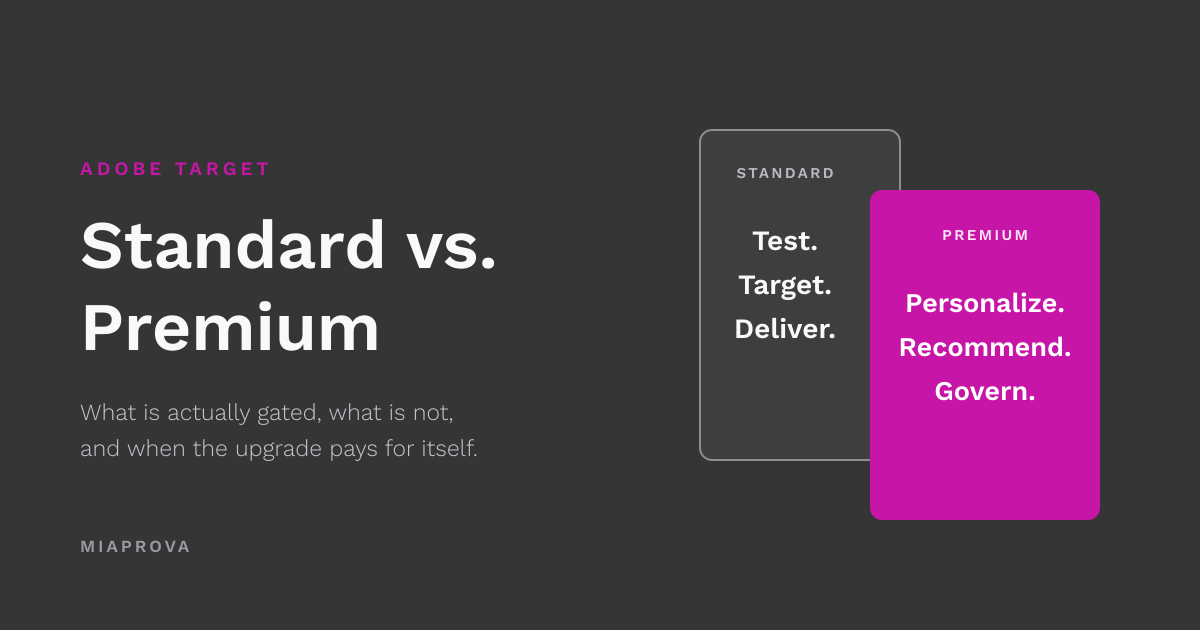
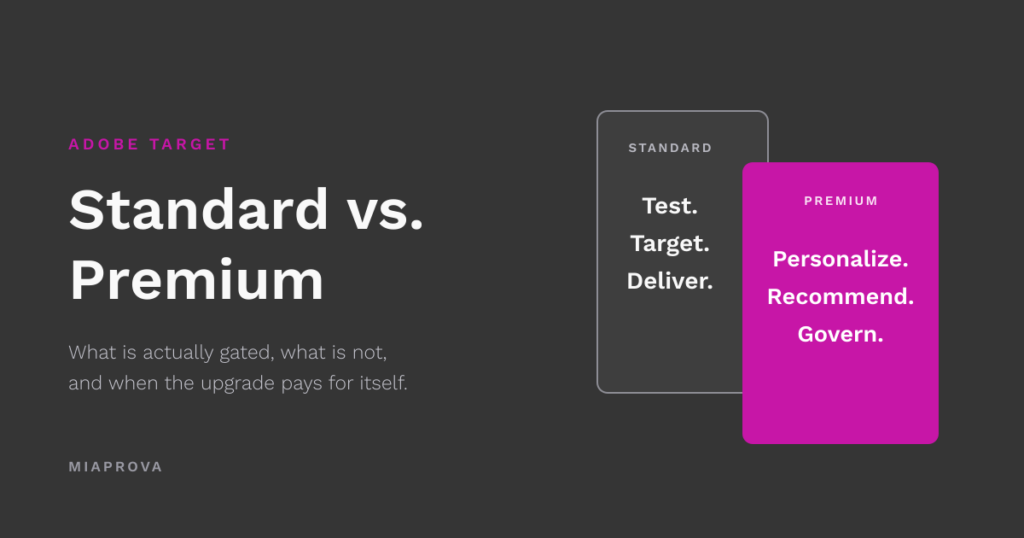
Adobe Target ships in two packages. Standard is the full testing and rules-based targeting platform. Premium is a license entitlement layered on top of it that unlocks five additional capabilities.
That last part matters more than most people realize. Premium is not a different product, a different implementation, or a migration. It is the same delivery infrastructure, the same at.js or Web SDK deployment, and the same profile store. Flipping the entitlement changes what the interface exposes. Your tag deployment does not change.
Here is the entire list of what Premium adds.
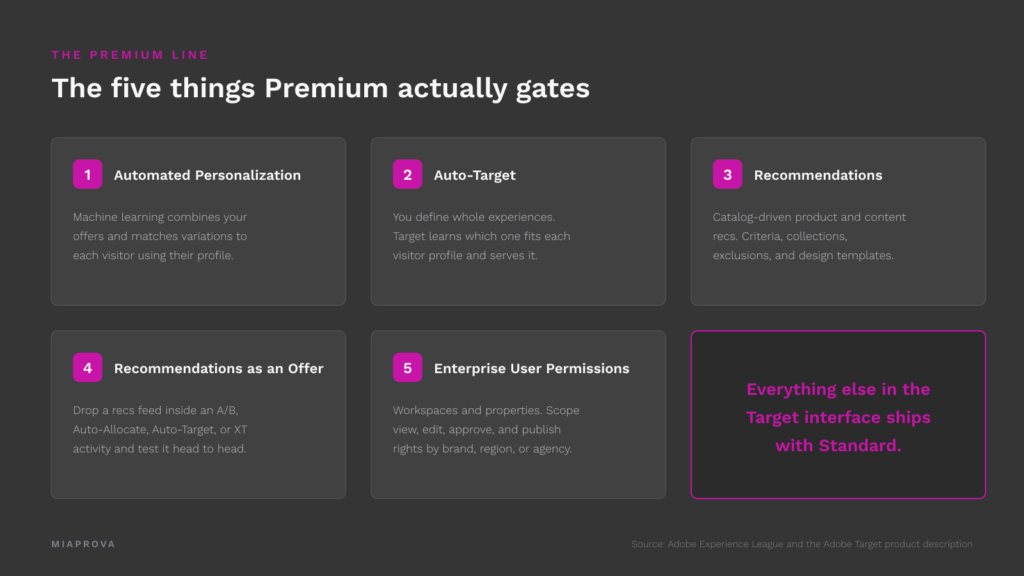
Automated Personalization uses machine learning to combine your offers and match variations to individual visitors based on their profile. You supply the content, the models assemble the experience.
Auto-Target works one level up from that. You define whole experiences, and Target learns which one fits each visitor profile, holding back a randomized control group so you can measure lift honestly.
Recommendations is catalog-driven product and content selection. Criteria, collections, entities, exclusions, promotions, and design templates all become first-class objects you manage.
Recommendations as an Offer lets you drop a recs feed inside an A/B, Auto-Allocate, Auto-Target, or Experience Targeting activity. This is the feature that turns Recommendations from a black box into something you can actually test.
Enterprise User Permissions gives you workspaces and properties, so you can scope view, edit, approve, and publish rights by brand, region, environment, or agency.
That is the list. Everything else in the Target interface ships with Standard.
Five things people get wrong
The confusion around this topic is remarkably consistent. These are the five corrections we find ourselves making over and over.
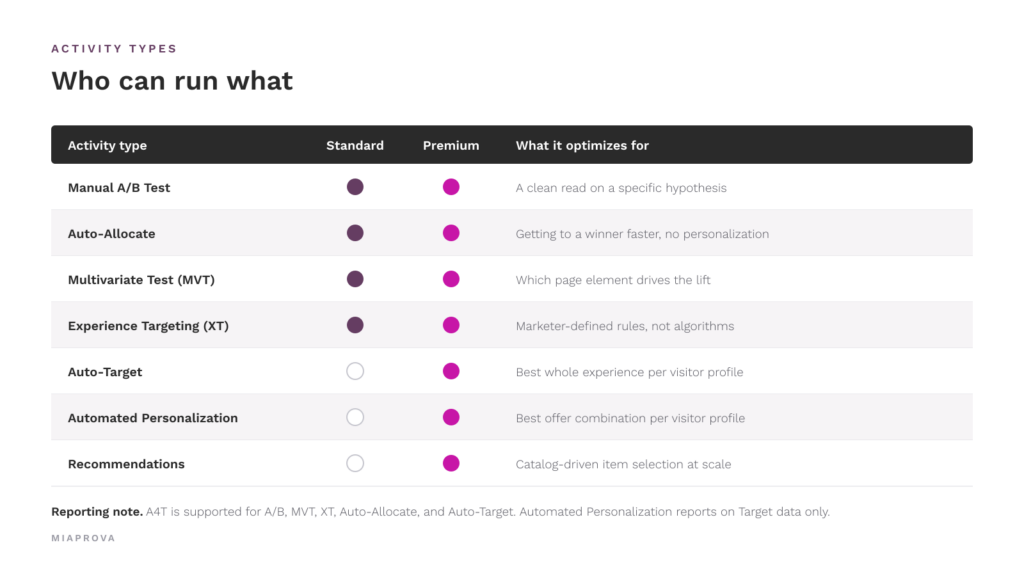
Auto-Allocate is not a Premium feature. Adobe’s product description lists auto-allocate under Standard entitlements, right alongside A/B and multivariate testing. Multi-armed bandit testing, with automatic traffic reallocation toward the winner, is available to every Target customer. This is the single most expensive misconception in the ecosystem, because teams run slower manual tests for years while a faster method sits unused in their account.
Standard is not web only. It covers desktop web, mobile web, mobile applications, email, and server-side digital experiences such as kiosks, all through the same Delivery API.
You do not need Premium for Adobe Analytics reporting. Analytics for Target is an integration between two products, not a tier of one of them. Standard customers can and generally should use Analytics as the reporting source. The one exception worth knowing is that Automated Personalization reports on Target data only, so an AP program needs its own measurement story.
Multivariate testing is not the advanced option. MVT feels sophisticated, so people assume it must be gated. It is Standard, and it is older technology than the machine learning activity types, not newer.
Upgrading does not mean rebuilding. Same library, same delivery calls, same profile store. The entitlement changes what the UI exposes and nothing else.
A better way to frame the decision
Feature lists are a bad way to decide this, because they invite the wrong question. The right frame is a ladder, where each rung asks less of the marketer and more of the algorithm.
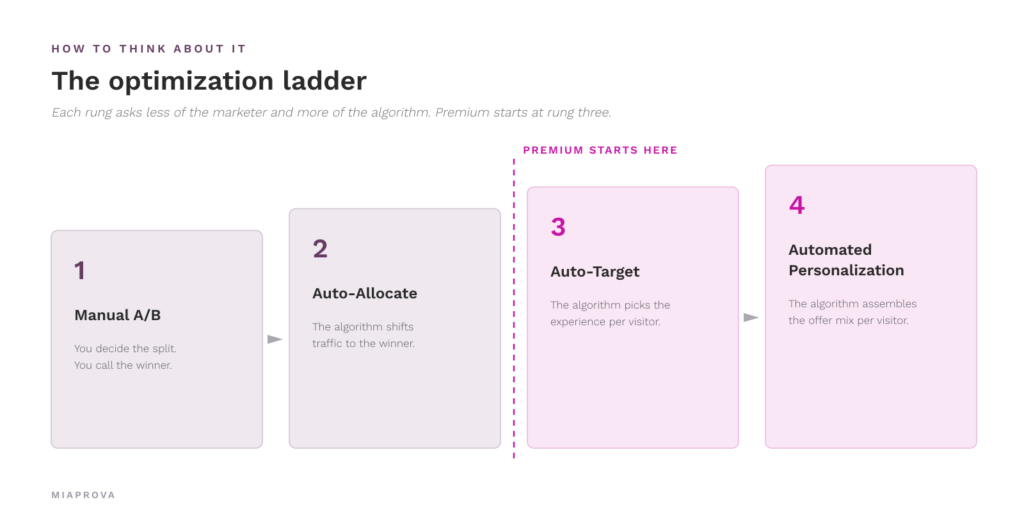
Rung one is a manual A/B test. You decide the split and you call the winner. Rung two is Auto-Allocate, where the algorithm shifts traffic toward the winner while the test runs. Both of those answer the same underlying question: which experience is best on average?
Rung three is Auto-Target, where the algorithm picks an experience per visitor. Rung four is Automated Personalization, where the algorithm assembles the offer mix per visitor. These answer a different question entirely: which experience is best for this person?
Premium starts at rung three. That shift, from “best on average” to “best for this person,” is the actual upgrade decision. Not the feature count.
The capability nobody demos
Here is the part that surprises people. In our experience, the item on the Premium list that most often drives a real upgrade is not the machine learning. It is Enterprise User Permissions.
Workspaces are Product Profiles in the Adobe Admin Console. The mental model is close to report suites in Analytics: a container that scopes what a user can see and touch. Bind a workspace to specific properties, meaning sites, domains, or apps, and a brand team logs in to see only their own activities and audiences. Layer in the Observer, Editor, and Approver roles, and publish rights become a deliberate grant rather than a shared password and a prayer.
For an organization with multiple brands, several regions, an agency partner or two, and an audit requirement that dev, stage, and production stay separated, this is not a nice-to-have. It is the thing that lets a program scale past a single team without someone eventually publishing to production by accident.
If you want to know which tier an account is on in about four seconds, create an activity and look for the Choose Workspace dropdown. No dropdown means Standard.
When each one is right
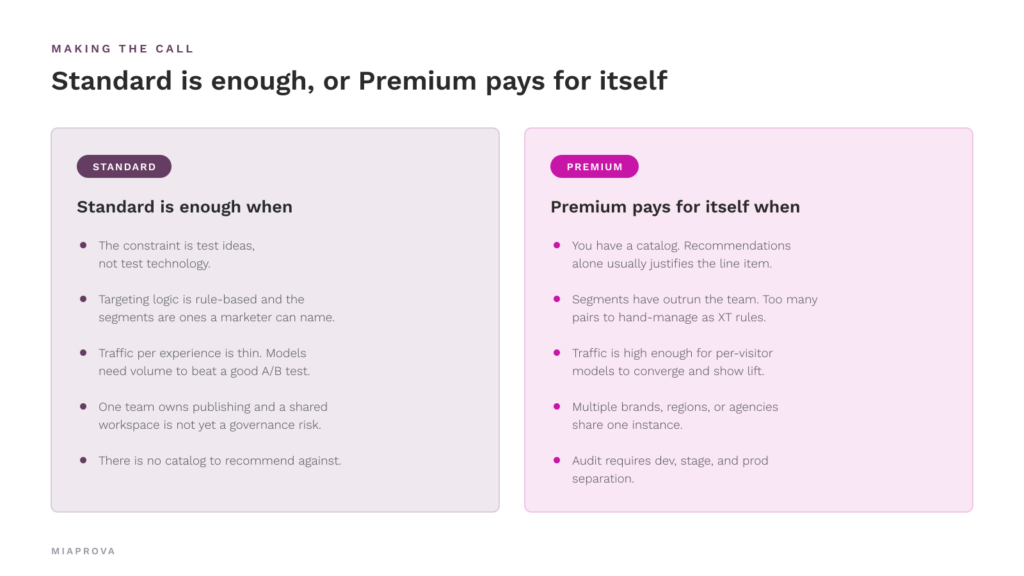
Standard is enough when the constraint on your program is test ideas rather than test technology. It is enough when your targeting logic is rule-based and your segments are ones a marketer can articulate out loud. It is enough when traffic per experience is thin, because personalization models need volume before they can beat a well-run A/B test. And it is enough when one team owns publishing and a shared workspace is not yet a governance risk.
Premium pays for itself when you have a catalog. For retail, media, and financial services, Recommendations alone usually justifies the line item. It pays for itself when your segments have outrun your team, meaning there are too many audience and experience pairs to keep hand-managing as XT rules. It pays for itself when traffic is high enough that per-visitor models can converge and demonstrate lift against control. And it pays for itself when multiple brands, regions, or agencies share one instance and need separated publish rights.
Worth knowing before you sign
Both tiers carry the same performance guardrails: five audiences per call, fifty activities per call, one hundred profile scripts per call, five hundred experiences per activity, fifty reporting segments and one hundred success metrics per activity, one thousand unique values per targeting rule, fifty targeting rules per audience, and a seventy-five kilobyte ceiling per offer.
Premium adds two of its own. You get up to ten Recommendations environments, and Recommendations, Auto-Target, and Automated Personalization together may not exceed ten activities per call. That second one is easy to overlook and it bites multi-brand catalog programs first. Worth modeling before you commit, not after.
These are scoping limits rather than hard technical caps, which means exceeding them does not throw an error. It just means you own the performance consequences.
Our honest take
Most organizations underuse Standard long before they need Premium.
We say that as a company whose product exists to help teams run better optimization programs, so it would be easy for us to say the opposite. But the pattern is consistent. When a team is not yet running a steady cadence of clean, well-instrumented tests with clear hypotheses and trustworthy measurement, handing decisions to a model does not fix that. It obscures it, because the algorithm will happily optimize toward a metric nobody validated.
The honest upgrade conversation starts with a question about your current program, not about the feature list. Are you running enough well-instrumented tests that the constraint has genuinely become the technology? If yes, Premium is likely to pay for itself quickly. If not, the money is better spent on the practice.
If you want to talk through where your program sits, we are always up for that conversation.
Sources: Adobe Experience League, “Introduction to Target” and “Target activity types,” and the Adobe Target product description, last updated 26 March 2026. Verified August 2026. Adobe changes packaging periodically, so confirm current entitlements with your Adobe account team before making a licensing decision.